What we talk about when we talk about institutional design
If you’ve been following the conversation around the design of scientific institutions and funding strategies, you may have come across a table breaking down how different characteristics map onto different mechanisms.
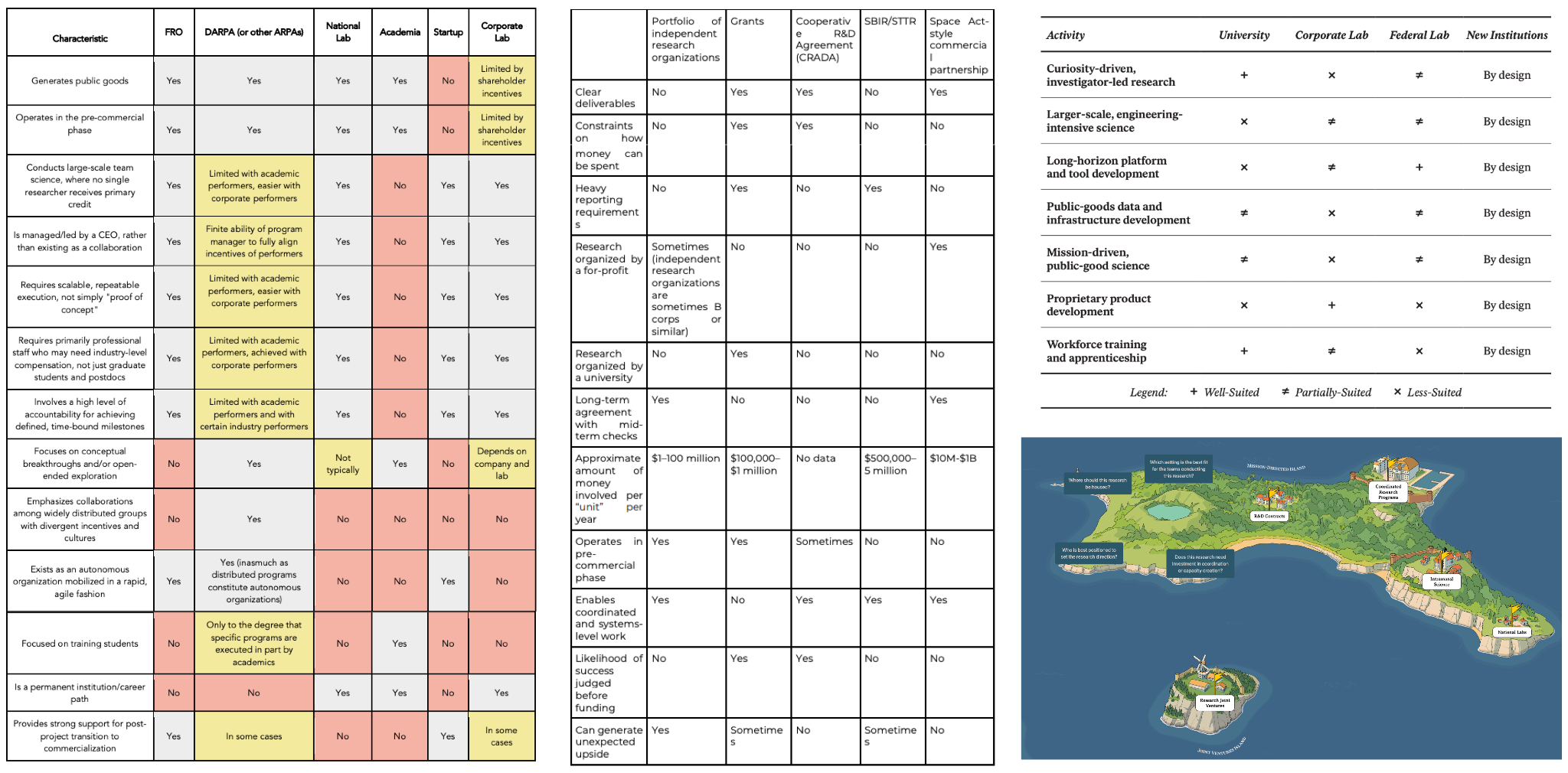
Last week Hiya Jain, Stuart Buck, and Aishwarya Khanduja published “A Taxonomy of R&D Orgs”, an excellent longform contribution to this tradition that distills the multidimensional differences between research organizations into nine key parameters: (1) optimal project timeline, (2) level of user input, (3) size of discretionary research budgets, (4) career incentives, attracting talent, and personnel models, (5) revenue strategy, (6) degree of focus on a single mission, (7) size of organization and/or research teams, (8) governance and project selection mechanisms, and (9) openness and IP strategy.
They go deep on each, exploring the range of possibilities and laying out case studies of institutions that sit at different points on the spectrum. It serves as both taxonomy and history (e.g. I did not know that staff scientist/engineer roles in part emerged as a result of early ARPA block grants to CMU, MIT, and Stanford), and will be a useful resource as the scientific ecosystem tests out a wide range of new (and old) models.
- https://substackcdn.com/image/fetch/$s_!8ETb!,f_auto,q_auto:good,fl_progressive:steep/https%3A%2F%2Fsubstack-post-media.s3.amazonaws.com%2Fpublic%2Fimages%2F876e8b27-f957-43e7-99e9-4b68cb942e89_2048x1010.png
- https://fas.org/wp-content/uploads/2020/09/Focused-Research-Organizations-to-Accelerate-Science-Technology-and-Medicine.pdf
- https://ifp.org/wp-content/uploads/2022/01/Fund-Organizations-Not-Projects-Diversifying-Americas-Innovation-Ecosystem-with-a-Portfolio-of-Independent-Research-Organizations_final.pdf
- https://www.whitehouse.gov/wp-content/uploads/2026/07/Science-A-New-Golden-Age.pdf#page=43
- https://atlasofinnovation.org/
- https://www.nber.org/papers/w35549
- https://analogue.press/p/a-taxonomy-of-r-and-d-orgs
- https://www.convergentresearch.org/
- https://www.nsf.gov/funding/initiatives/nsf-x-labs
- https://institute.global/insights/tech-and-digitalisation/a-new-national-purpose-reimagining-uk-science-and-technology-through-lovelace-disruptive-invention-laboratories
- https://www.freaktakes.com/p/the-bbn-fund