Why biotech companies go to Australia
This week I read what I wished I was reading last week: a detailed explanation of how Australia’s clinical trial system compares to that of the United States. The key difference is in their phase one trials, which are the first test of a new drug in humans. They’re used to get an initial sense of the drug’s safety, but can also provide biological clues as to its efficacy, and be used to learn, iterate and improve, before drugs progress into the later and more expensive stages of clinical trials. In a recent report for IFP, Ruxandra Teslo and Adam Kroetsch explain why Australia does these trials faster: in short, they use more streamlined pathways and make asks that are proportional to risk.
I found the specifics quite interesting and sometimes surprising: in the US, the FDA decides whether a phase one trial can proceed, while in Australia, this is left to independent ethics committees. Drug developers in the US generally get only one formal meeting with the FDA before submitting their application to start a phase one trial, while Australian committees can meet with them weekly, which helps them learn more precisely what to include. FDA reviewers typically ask for months of stability testing for the drug, even if it is only used for hours, days or weeks, while Australia asks for testing that covers the dosing period. Australia also accepts research-grade components for the laboratory tests in an application, rather than pushing developers toward using commercial grade components, as the FDA tends to do. Australian developers can also submit different components as they become ready, rather than waiting to compile everything at once. And while US applications face a fixed 30-day waiting period before the trial can proceed, Australia’s do not. All that results in a more streamlined process that’s, in my view, more reasonable, predictable and, on average, several months shorter.
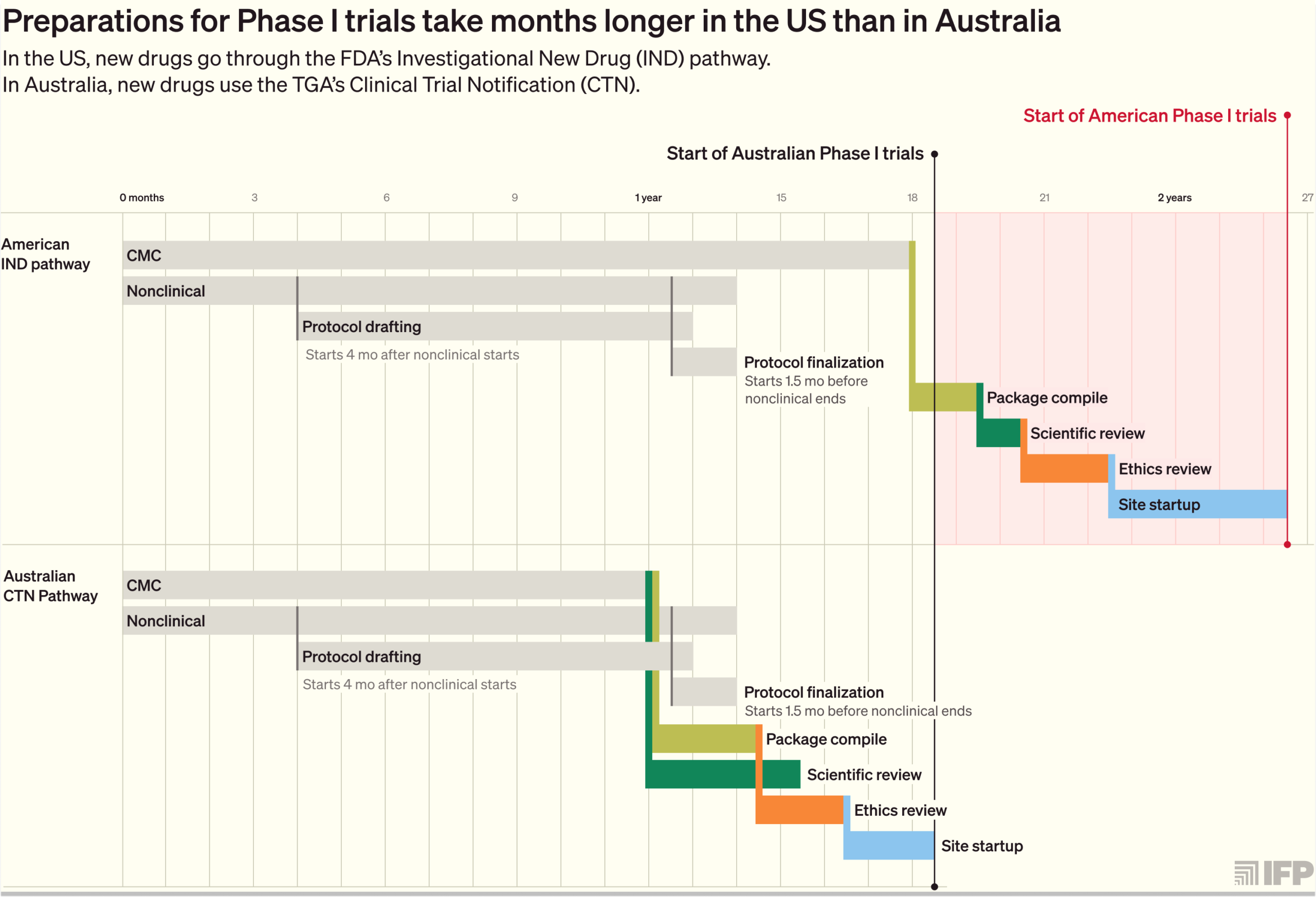
This all matters because delays have a range of consequences. One, for learning: the process of iteration and learning happens faster if scientists can start running trials faster, which hopefully improves a drug’s success rates at later stages. Another is for patients in the trials themselves: if they have a terminal disease, months of delay can mean it becomes too late for them to receive the drug. And this effect applies more broadly to patients outside trials too, if the overall timeline (from research to an effective drug becoming available) is reduced. It’s a great example of how, sometimes, saving more lives isn’t about improving a new drug’s efficacy, safety, or accessibility, but just getting it to patients faster.
- https://www.abundanceandgrowth.org/p/what-we-wish-we-were-reading
- https://ifp.org/why-biotech-companies-go-to-australia-to-test-new-drugs/
- https://substackcdn.com/image/fetch/$s_!9PHL!,f_auto,q_auto:good,fl_progressive:steep/https%3A%2F%2Fsubstack-post-media.s3.amazonaws.com%2Fpublic%2Fimages%2F43206463-6b4c-4b32-ae49-8f9ecc997989_2560x1745.png