Giving up on homeownership
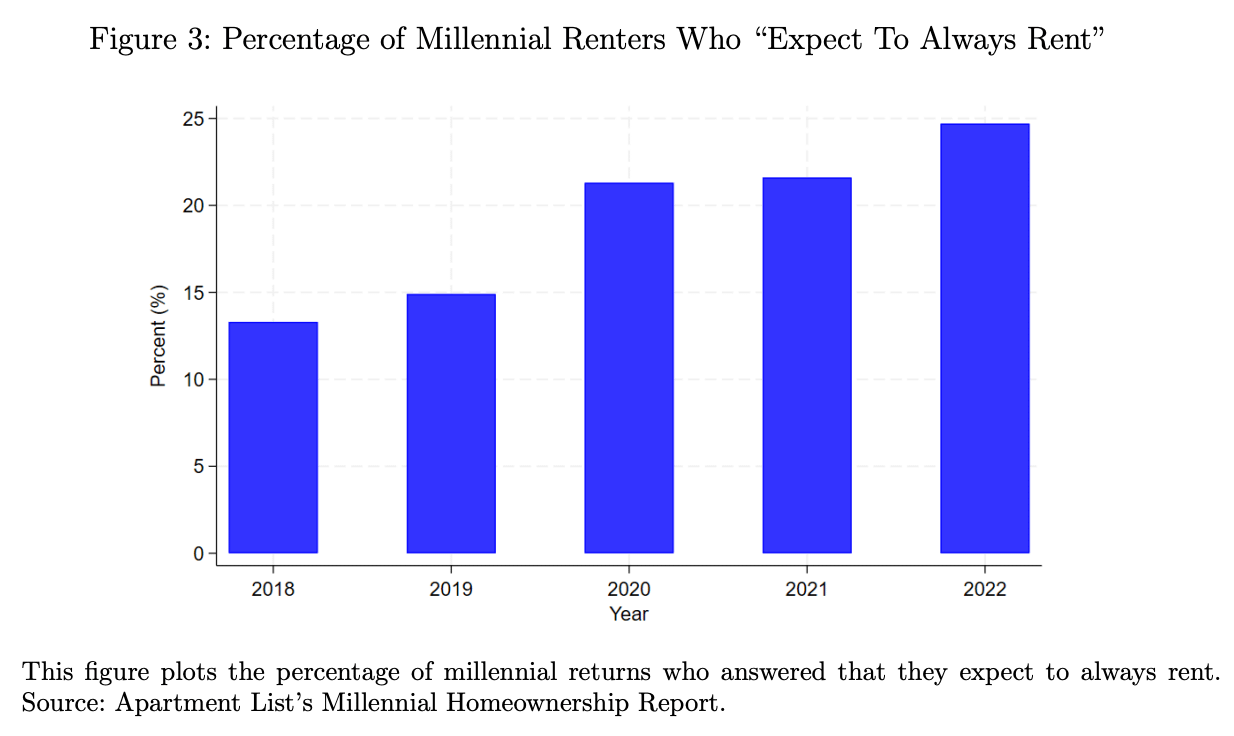
As I’ve written before (see item #3 here), the housing shortage is disproportionately affecting the young, with first time buyers and renters paying unusually large shares of their income to housing, compared to long run trend. A 2025 working paper by Lee and Yoo looks at what happens when owning a home becomes out of reach. They argue that when people decide that a home of their own is unattainable, they give up on home ownership which leads to a cascade of behavior changes: less saving, less hard work, and more interest in riskier investments.
Lee and Yoo present a variety of evidence to back up their argument. The share of Millennials who report they expect to rent forever has risen from under 15% in 2018 to 25% in 2022, and the share who say they currently have $0 saved for a house down payment is up from 48% to 67% over the same period. Lee and Yoo also conduct several comparisons of renters and homeowners, focusing on people with a low to medium net worth: this group has higher monthly credit card spending, is more likely to say “ Working hard: always giving my best effort” is not important, and more likely to invest in cryptocurrencies. These behaviors can be reinforcing; those with an income just below the threshold needed to buy a house end up with much less wealth and income than peers whose income is just above the threshold. The paper is a bit of a grim complement to the set of papers I recently wrote about for my post The non-material consequences of growth, which looked at how slow growth is associated with less trust in your government, less trust in democracy, and more zero-sum thinking.
- https://substackcdn.com/image/fetch/$s_!CT8s!,f_auto,q_auto:good,fl_progressive:steep/https%3A%2F%2Fsubstack-post-media.s3.amazonaws.com%2Fpublic%2Fimages%2F7de72061-433f-46bf-859e-3fcae60239ab_1234x736.png
- https://www.abundanceandgrowth.org/p/what-were-reading-april-17-2026
- https://papers.ssrn.com/sol3/papers.cfm?abstract_id=5770722
- https://mattsclancy.substack.com/cp/215649535