GDP makes you better off, but it’s not the meaning of life
GDP per capita is positively correlated with a lot of desirable things, like health and subjective well-being (even though self-reported well-being in the United States has been falling for the last decade, it remains roughly at the level one would expect given our GDP per capita!). But GDP is not everything - it turns out reports of meaning in life actually decline with GDP per capita! Is this because “The meaning of life is a problem for people who are not desperate, people who can count on survival, comfort, security, and some measure of pleasure”, as social psychologist Roy Baumeister once wondered?1
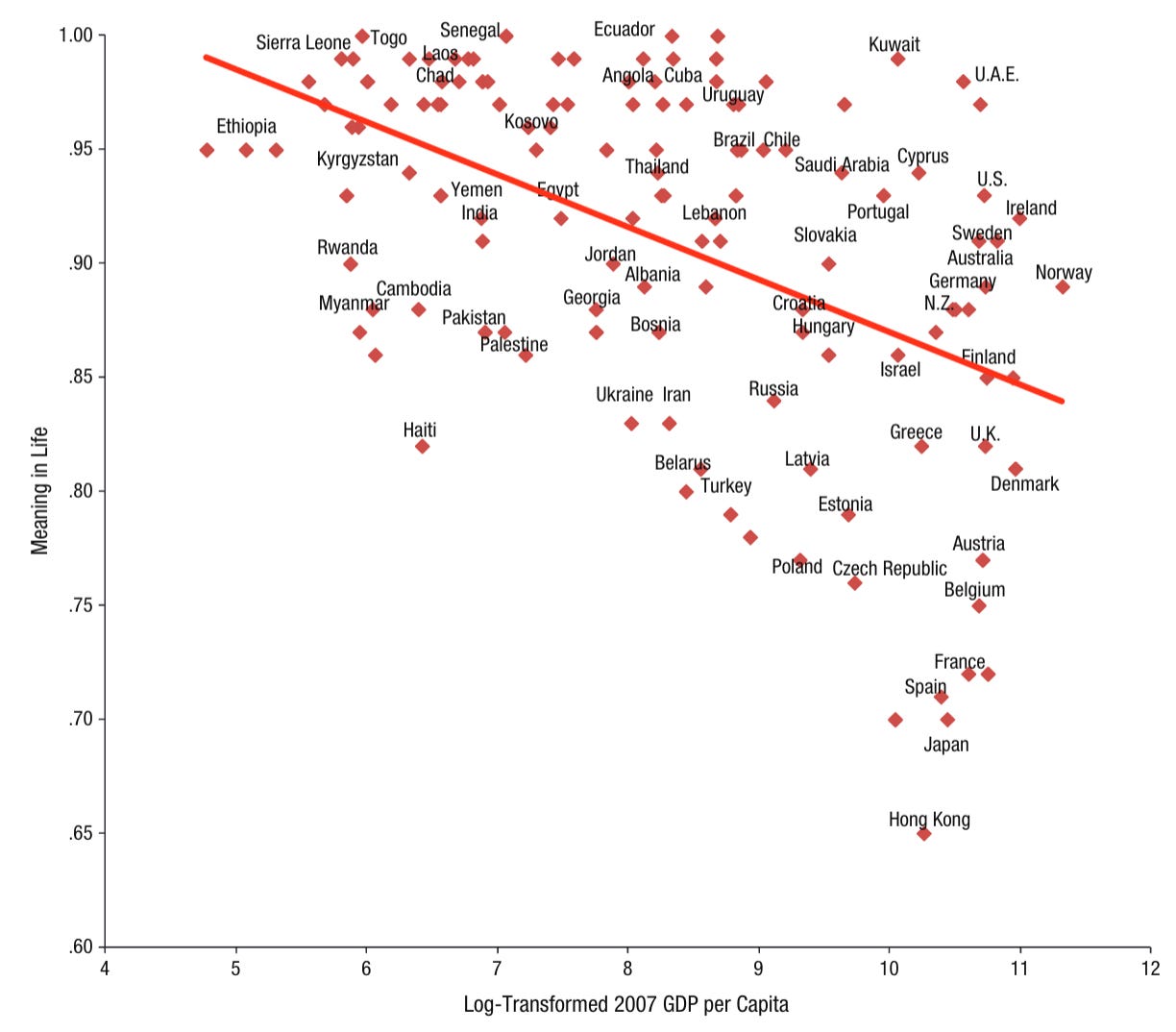
Maybe not. A 2014 paper by Oishi and Diener argues this effect is actually driven by religiosity. Religiosity is positively correlated with meaning; it’s just that religiosity is also negatively correlated with the GDP per capita. If you try to predict meaning with two variables - religiosity and GDP per capita, religiosity carries the day and GDP per capita no longer carries any additional predictive value. Indeed, when the data was collected, the US was actually an unusually religious high income country, and also a leader among high income countries in terms of how meaningful its residents find their lives. US religiosity has dropped substantially since 2007 though, and so I suspect a repeat of the study may not find the same results.
- https://mattsclancy.github.io/2026/04/23/us-happiness-easterlin.html
- #footnote-1
- https://substackcdn.com/image/fetch/$s_!v1FO!,f_auto,q_auto:good,fl_progressive:steep/https%3A%2F%2Fsubstack-post-media.s3.amazonaws.com%2Fpublic%2Fimages%2F99c76dd3-a22c-4f9a-88dc-582e12b9a909_1224x1074.png
- https://journals.sagepub.com/doi/10.1177/0956797613507286