OMB’s intrusion into NIH
When an agency proposes a significant regulatory action, the Office of Information and Regulatory Affairs (OIRA) has the power to first evaluate it to ensure alignment on policy and the minimization of regulatory conflicts. This review step slows down policymaking, but that might be worth it if the review helps avoid costly regulatory errors. Given that the review is intended to be used for significant regulatory action, it is no surprise that it has not often been used at the National Institutes of Health, which primarily fund research rather than regulate.
But as Christopher Marcum notes in a guest post for the Good Science Project, something has changed in 2026. We’re not even all the way through 2026, but 27% of NIH documents ever reviewed by OIRA were documents from 2026. Even more puzzling, since this specific OIRA review power was established in 1993 (under Executive Order 12866), it has never before bothered to review NIH requests for information; now it is reviewing all of them. The upshot is a slowdown in the ability of the NIH to make policy changes.
NIH seems to be the subject of special attention here - there has been no uptick in review of documents at NSF, the other large federal science grantmaker. Meanwhile, there are other signs of conflict between NIH and OMB (where OIRA is housed). The Washington Post reports that NIH director Jay Bhattacharya refused a recent request from the president to cut funding to Harvard, and in response OMB Director Russell Vought proposed the creation of a board that would oversee NIH grantmaking. According to reporting from Politico, the proposed board would include Vought and need to reach unanimous agreement for all grants, essentially giving OMB a veto over NIH grant decisions. As we’ve written about before (see Jordan’s sections of this post and this post), this follows OMB’s other attempts to expand political control over the scientific grantmaking process. So far those efforts have been put on pause.
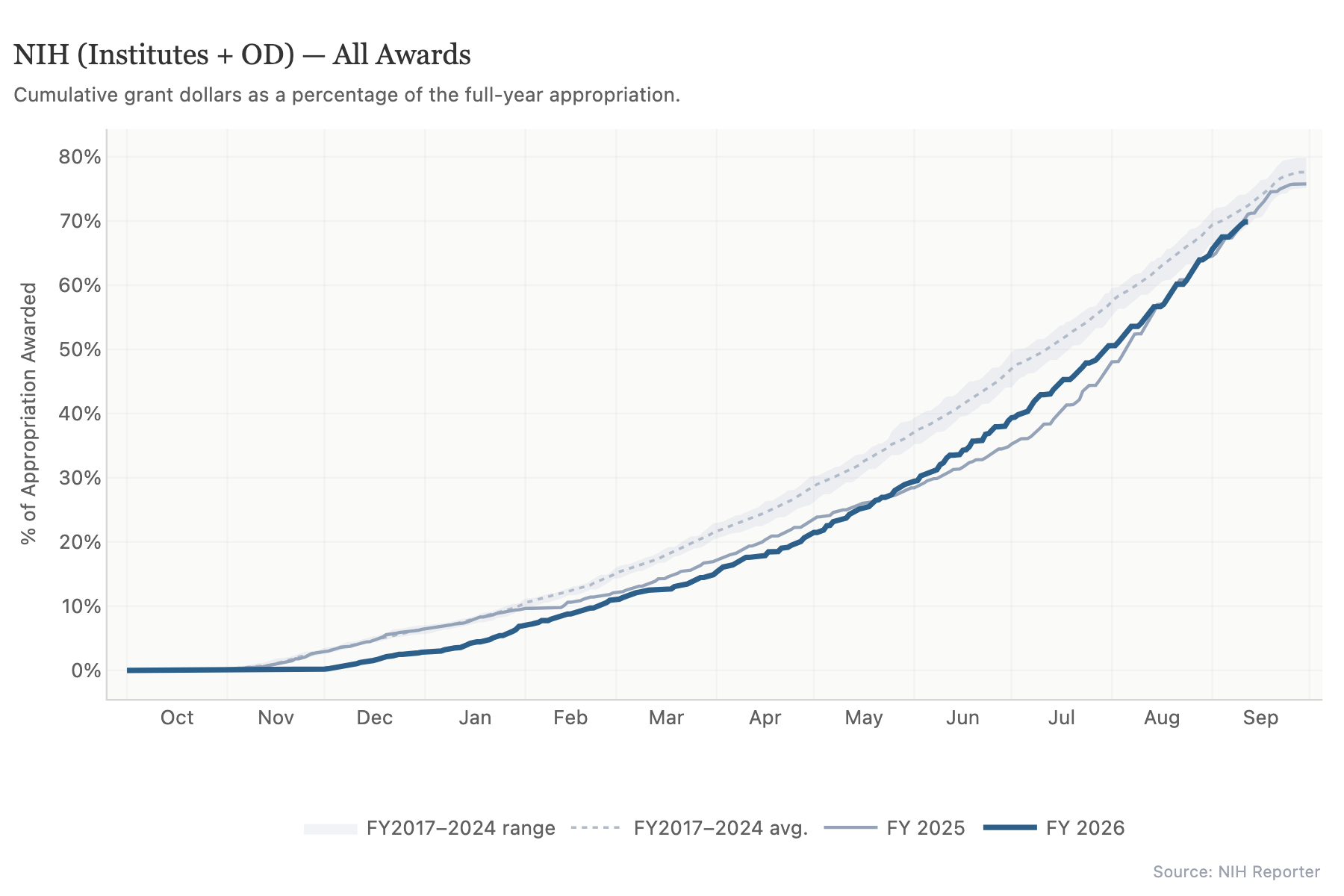
It’s worth noting that despite the interference, NIH in 2026 is close to being on track to spend the funds that had been appropriated to it according to Jordan Dworkin’s science spending tracker.
- https://newsletter.goodscienceproject.org/p/policy-impoundment
- https://www.washingtonpost.com/politics/2026/09/18/vought-pushes-scrutiny-nih-grants-oval-office-clash/
- https://www.politico.com/news/2026/09/19/nih-grants-trump-vought-bhattacharya-harvard-01085413
- https://www.abundanceandgrowth.org/p/the-road-acts-124-to-do-items-space
- https://www.abundanceandgrowth.org/p/the-idiot-index-for-housing-412-pages
- https://sciencespending.org/#overview
- https://substackcdn.com/image/fetch/$s_!biit!,f_auto,q_auto:good,fl_progressive:steep/https%3A%2F%2Fsubstack-post-media.s3.amazonaws.com%2Fpublic%2Fimages%2Ffeb2853a-ab95-4b67-9e72-4c95288dd9cb_1800x1200.png